

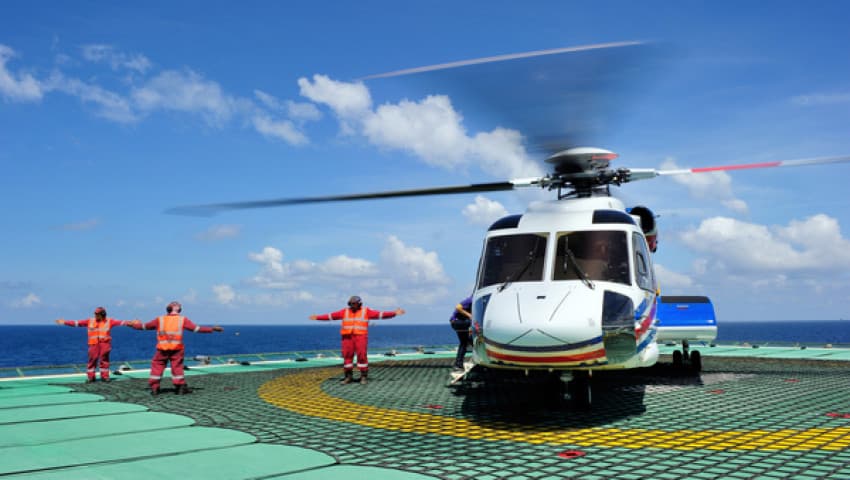
A monsoon morning on the pool deck at Njarakkal, and why we drill helicopter escape with CA-EBS until it lives in the body, not the head.
The rain came down hard over Njarakkal this morning, the kind of July downpour that turns the backwaters grey and sends everyone running for the covered walkways. Inside the pool hall it was warm and loud, and a young man from Kollam was sitting on the edge of the HUET module, goggles pushed up on his forehead, waiting for his turn to go under.
He had passed everything else that week. The induction, the sea survival, the firefighting. But he told me, quietly, that this was the one he had been thinking about since he booked the course. Being strapped into a seat, tipped upside down in the water, and made to find his own way out.
I have watched a few thousand people go through that module over the years, and I can tell you the fear he was feeling is the correct response. That is the whole point of it.
For those outside the industry, let me explain what has changed. For a long while now, the standard for helicopter escape training has moved to what we call CA-EBS, compressed air emergency breathing system. It is not a nice-to-have any more. If you are flying offshore to a rig or a platform, the expectation across the Gulf operators is that you have trained with it. The old rebreather systems, where you exhaled back into a bag, had real limitations in cold water and at depth. Compressed air gives a man a genuine, reliable supply of air for those critical seconds after a ditching, when the cabin is filling and everything is dark and upside down and your instinct is screaming at you to breathe.
Here is the part I try to make every candidate understand before they get in the water. Deploying that system while inverted and disoriented is not natural. You have to reach, activate, clear, and breathe, in an order, with cold water on your face and your heart going like a drum. If the first time you ever do it is in a real emergency in the North Sea or off Abu Dhabi, you will not do it. Muscle memory is the only thing that works when the thinking brain shuts off. So we drill it. We make it uncomfortable on purpose, in a controlled pool with divers an arm's length away, so that the movement lives in the body and not just the head.
The young man from Kollam went under four times before he had it clean. On the last one he came up, spat out his mouthpiece, and laughed. Not because it was funny. Because his body finally believed it could do the thing his mind had been dreading all week. That moment, that shift from dread to competence, is the reason this centre exists.
We are seeing a lot of these faces right now. Every year the monsoon months bring a wave of men home to Kerala for their certification and recertification, timed around leave from the Gulf. Some are going out for the first time, nervous, a parent waiting in the reception hall. Many are experienced hands whose four-year HUET validity is running out and who know they cannot board that helicopter without a current certificate. The OPITO certification runs four years, and the operators do not bend on it. I have had grown men, senior technicians, drive down from the airport straight to our gate because their rotation depended on getting the stamp before flying back.
I want to say something to the families, because they read these things too. When your son or your husband complains that the training was hard, that they made him do the escape again and again, that the instructor would not let him off easy, please understand that this is us doing our job properly. A soft course that hands out certificates is not a kindness. It is a danger dressed up as one. The centres that cut corners are not helping anybody. The discomfort in our pool is the cheapest insurance any offshore worker will ever buy.
The rain has not let up as I write this. Out on the campus the practical yard is soaked and the sea beyond the coconut trees is the colour of steel. In an hour another group goes into the water. I will be there on the pool deck, as I have been for years, watching for that same moment on a new set of faces.
Stay safe out there. Come home to your people.